
Punakha Dzong: What to Expect When You Visit Bhutan's Most Beautiful Fortress
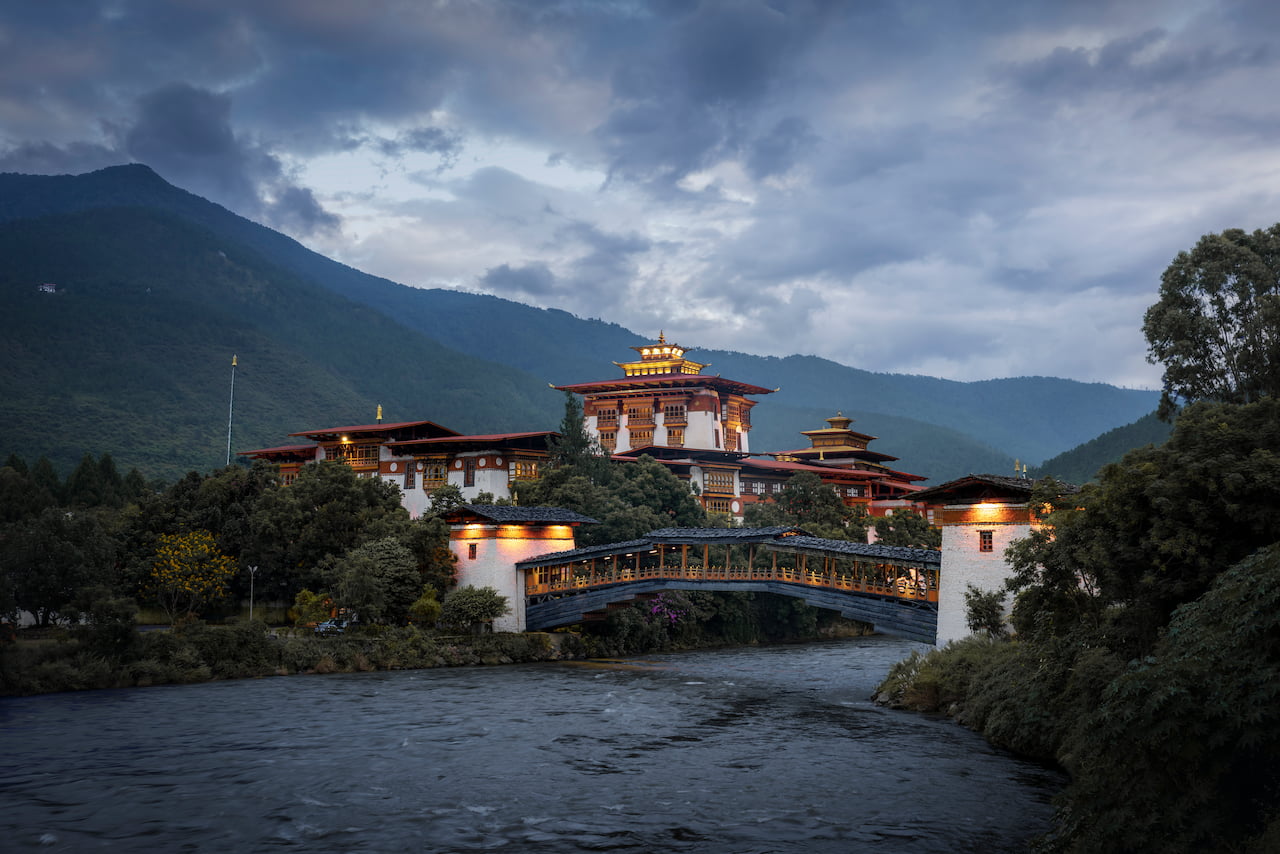
The first thing you do before you reach Punakha Dzong is cross a bridge.
It's a traditional wooden bridge, and for a structure this famous, the approach feels surprisingly unassuming at first. Then the dzong comes into full view on the other side and you understand why the bridge exists the way it does. You need that walk across the water. You need that moment of crossing over before you arrive.
Punakha Dzong sits on a narrow tongue of land where two rivers meet, the Pho Chu and the Mo Chu, meaning the male river and the female river. It doesn't sit beside the rivers. It sits between them, on its own, surrounded by moving water on both sides, as if it was placed there deliberately to exist slightly apart from the rest of the world. Which, in a way, it was.
What Punakha Dzong Actually Is
Punakha Dzong (formally Pungtang Dechen Photrang Dzong, meaning "the palace of great happiness and bliss") was built in 1637 by Zhabdrung Ngawang Namgyal, the Tibetan Buddhist lama who unified Bhutan as a nation. It served as the country's capital and seat of government until 1955, when the capital moved to Thimphu.
Before that move, Punakha was the centre of Bhutanese political life. The dzong was the meeting place for the three Penlops, the regional governors who ruled western, central, and eastern Bhutan under the monarchy. Everything of national significance happened here. Treaties were signed here. The first and second Kings of Bhutan were crowned here. It remains the winter residence of Bhutan's Chief Abbot (the Je Khenpo) and several hundred monks who move here from Thimphu each year when the cold sets in.
It is still a fully functioning religious and administrative building. What you're walking into is not a museum.
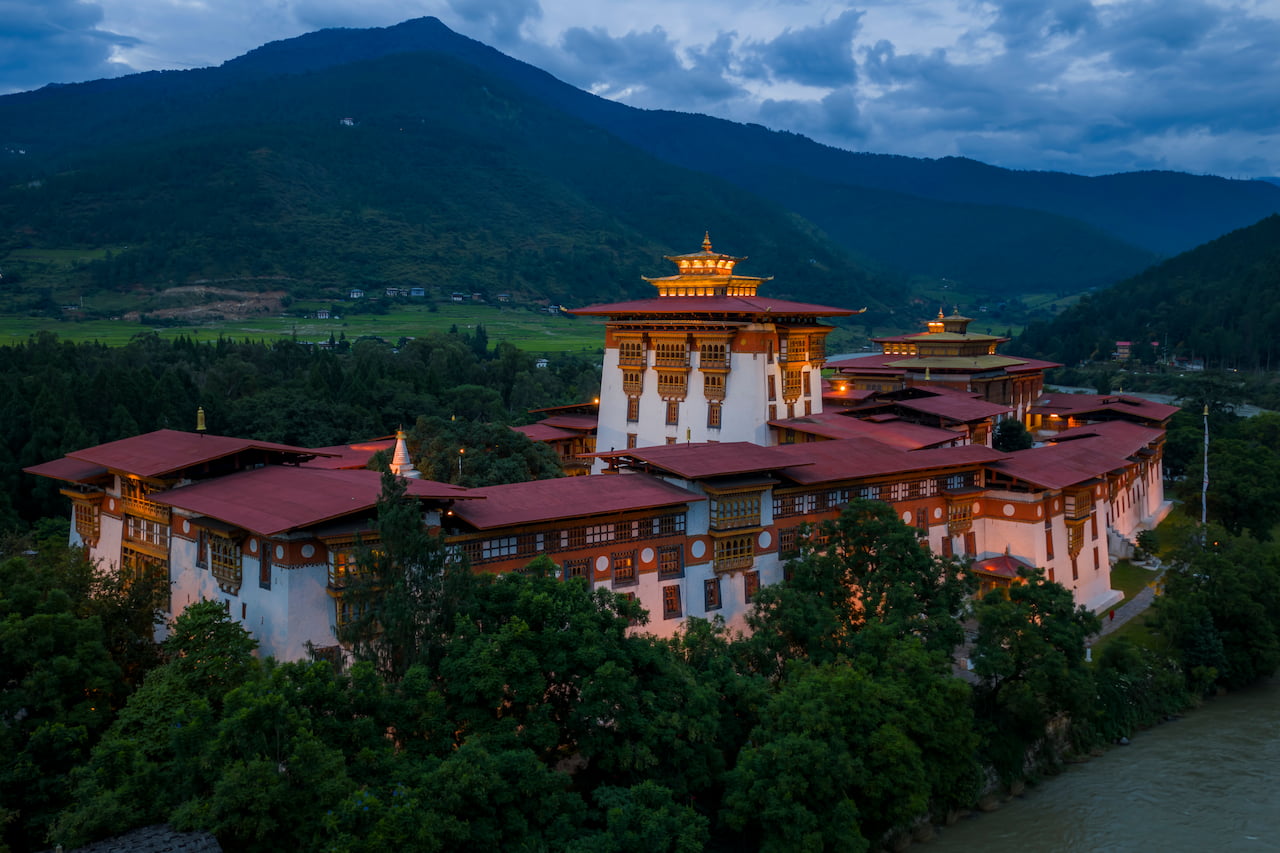
From above, the dzong's position becomes clear. Two rivers, one narrow strip of land, and a structure that has held its ground for nearly 400 years.
The Bridge, the Entrance, and the Three Stairs
Crossing the wooden bridge over the Mo Chu is one of those small moments that adds something you didn't expect. It's not long, and it's not dramatic. But you're crossing moving water to reach a fortress that has stood on this narrow piece of land for nearly four centuries, and that transition from the bank to the bridge to the dzong courtyard registers differently to simply walking up to a building.
Once you cross, you reach the main entrance: a towering gateway with thick whitewashed walls that taper as they rise, and three wide stone staircases leading up through the entrance. Not one staircase split into three. Three distinct staircases, deliberately built.
Each one was built for one of the three Penlops. When they came to Punakha for official meetings, each entered by their own staircase. Rank and protocol were built into the architecture itself. The building wasn't just where decisions were made. It was designed so that the way you approached it told everyone exactly who you were.
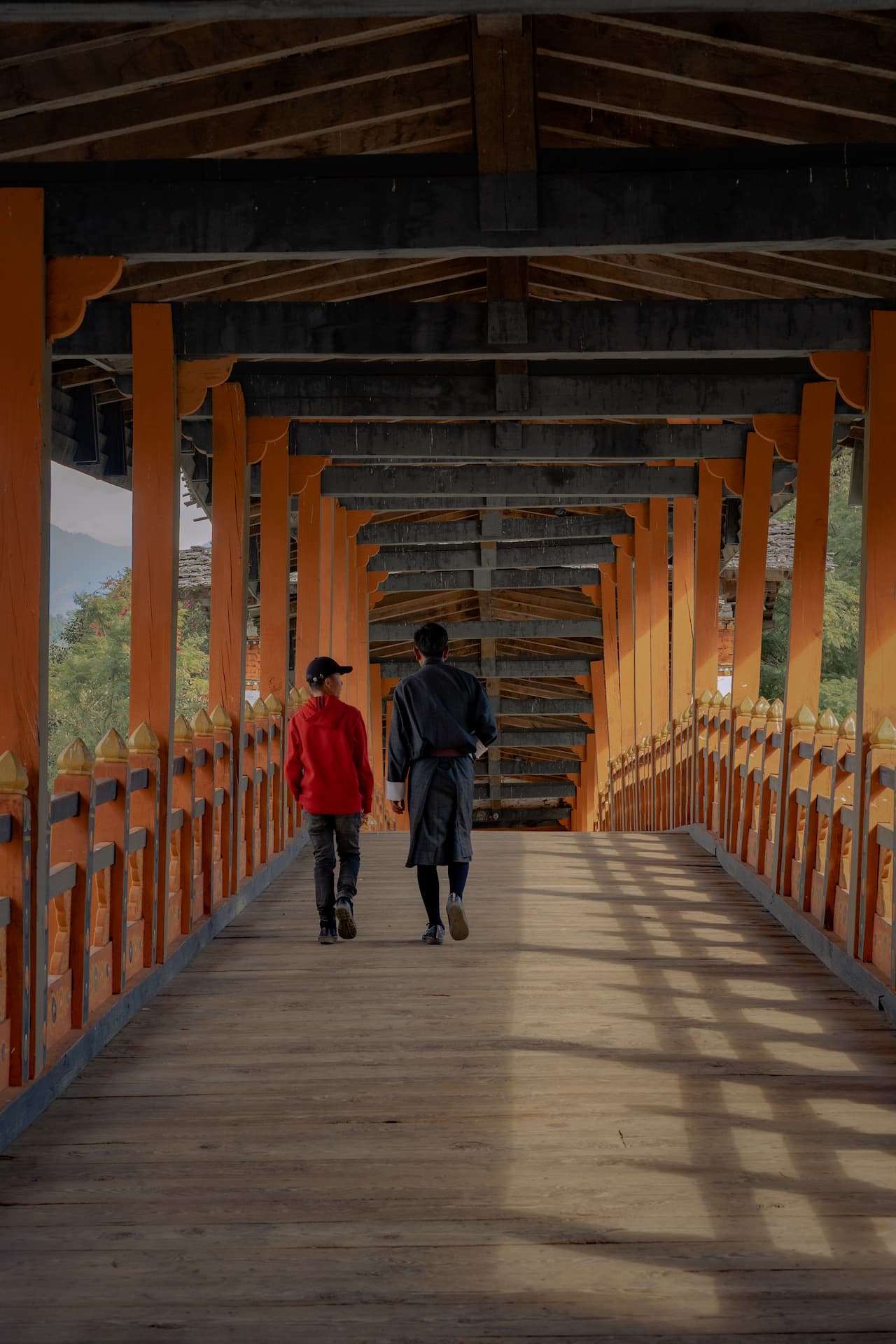
The bridge crossing is short, but it changes how you arrive. You don't just walk up to Punakha Dzong. You cross to it.
The Rivers, the Land, and a Question That Stays With You
Stand at the entrance and look left, then right. Both sides are river. The Pho Chu to the north, the Mo Chu to the south. The dzong occupies the entire width of the landmass between them. There is no buffer, no wide bank. Just the walls and the water.
When I first saw this, I thought about a documentary I'd watched as a kid about the Taj Mahal. The Taj Mahal is surrounded by water on its grounds, and one of the things that astonished engineers who studied it was the drainage system built underneath. An intricate network that allowed the water to pass through the ground without eroding the foundation beneath one of the heaviest structures ever built. People studying it centuries later were asking how anyone in that era had that level of engineering knowledge.
Punakha Dzong has nothing comparable underneath it. No documented drainage engineering, no foundation designed for two rivers pressing against it from both sides. And yet it has stood here since 1637, through floods, earthquakes, and four centuries of Himalayan weather.
There are no engineers in Bhutan's history who designed this. There are no blueprints that explain why the land holds. And Bhutan today, with everything modern construction has access to, would struggle to build something like this in this location.
That question sits with you longer than most things you see in Bhutan. Either the people who built it understood something we haven't properly documented, or this place is held up by something that isn't in any engineering manual. The Bhutanese themselves would tell you it's the latter, and after standing there looking at the rivers on both sides, it's hard to argue.
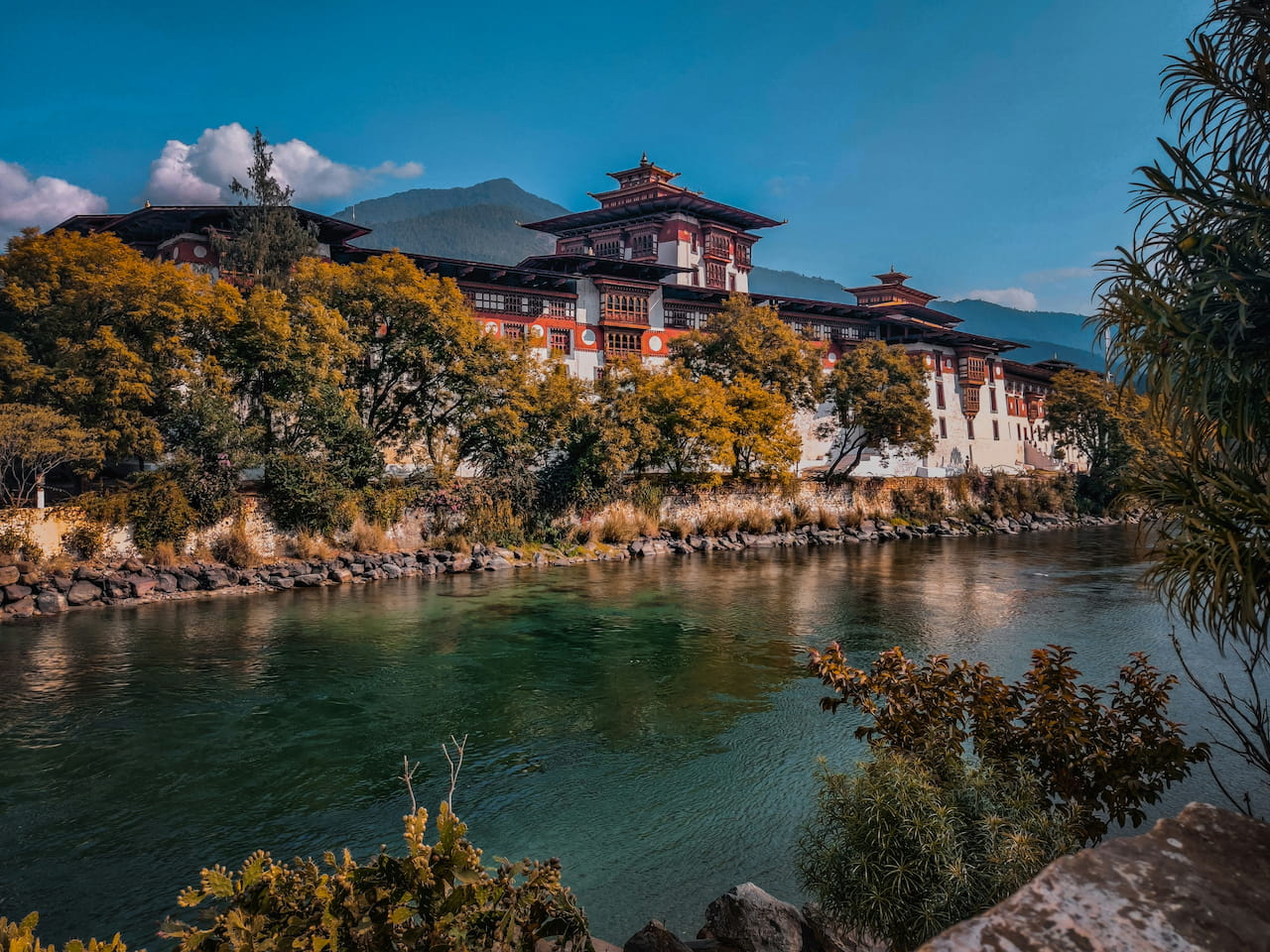
From the river you see it differently. The walls rise straight from the water. No buffer, no wide bank. Just stone and river.
The Jacaranda Trees
If you visit in February or early March, something else happens.
The courtyard of Punakha Dzong is lined with jacaranda trees, and in late winter they bloom in full purple before the leaves come back. The flowers fall slowly, covering the stone courtyard floor in a layer of purple against the white of the walls and the deep red of the monks' robes. It is one of those combinations that looks like it was staged and wasn't. The colour contrast between the jacaranda purple, the white dzong walls, and the gold of the roof ornaments is something photographers fly into Bhutan specifically to catch.
You don't need to visit in February to be moved by Punakha Dzong. But if your travel dates give you the option, it's worth adjusting your itinerary for.
Inside Punakha Dzong
The interior of Punakha Dzong is a series of courtyards, temples, and administrative halls connected by staircases and wooden walkways. Your guide will take you through the main areas.
The central utse (the tower at the heart of the dzong) houses the most sacred relics, including the Rangjung Kharsapani, a self-formed image of Avalokiteshvara that is considered one of Bhutan's most treasured religious objects. The main assembly hall is vast, dark, and painted floor-to-ceiling in traditional Bhutanese motifs. Butter lamps burn along the altars. The smell of incense is constant.
The upper levels look out directly over the confluence of the two rivers. On a clear day you can see the valley stretching north toward the higher mountains. On a misty morning the view disappears into white and comes back in sections.
Photography is restricted in certain interior areas. Your guide will tell you where. Follow their lead without needing to be told twice.
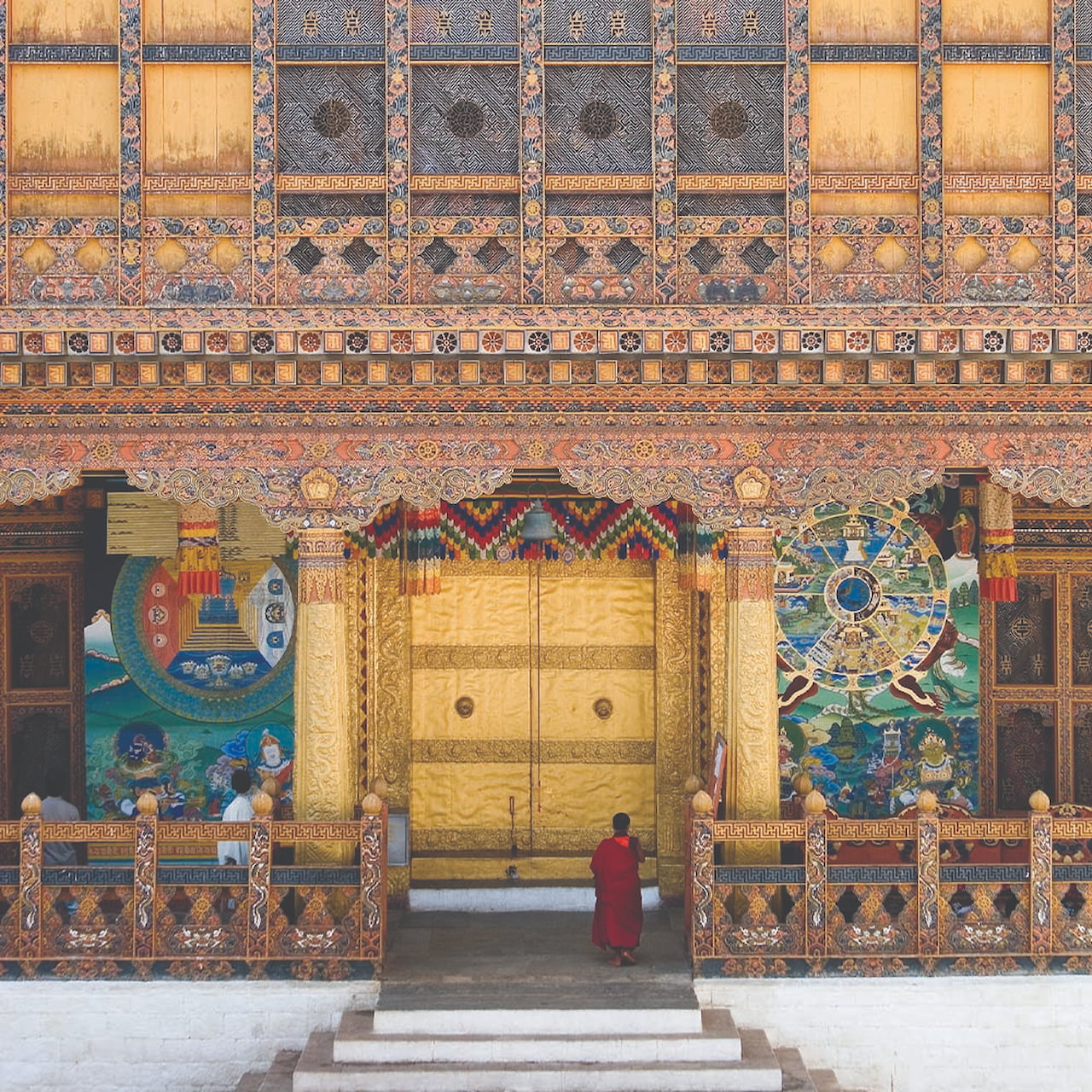
Inside, the dzong opens into courtyards, painted halls, and temple rooms that have been in continuous use since the 17th century.
What to Know Before You Visit Punakha Dzong
Covered shoulders and knees are required to enter. This is non-negotiable and applies to all nationalities and genders. If you arrive without appropriate clothing, you won't get in. Wear it from your accommodation or carry a scarf or light layer to put on at the entrance.
A proper visit takes one and a half to two hours. Less than that and you're rushing through something that deserves more time. If monks are conducting prayers when you arrive, wait. Watching a prayer session in a dzong of this scale is worth twenty minutes of your itinerary.
Entry is included in your Bhutan Sustainable Development Fee. Your guide will handle the permits. You don't need to organise anything separately.
This is an active place of worship and government administration. Walk slowly, speak quietly, and take photographs only where your guide confirms it's permitted.
Best Time to Visit Punakha Dzong
Punakha sits at around 1,200 metres above sea level, which makes it one of the warmer valleys in Bhutan. That warmth is an advantage in winter and a consideration in summer.
February to April
The jacaranda trees bloom in late winter, covering the courtyard in purple. Spring brings clear skies and comfortable temperatures. The strongest time to visit if you want the full visual experience of Punakha Dzong.
October to December
Clear skies, warm autumn light, and the valley at its most open. The Je Khenpo and the monks arrive from Thimphu for the winter, so the dzong is at its most active as a religious site.
June to August
Monsoon season. The rivers rise significantly and the valley turns an intense green. The dzong is still visitable and genuinely dramatic in the rain, but itineraries may need adjusting in heavy flood years. Your guide will know.
For a full month-by-month breakdown of the whole country, see our guide on the best time to visit Bhutan.
Getting to Punakha Dzong
Punakha is roughly 75 kilometres from Thimphu, about two and a half hours by road over the Dochula Pass. The drive is part of the experience. Dochula at 3,100 metres offers one of the finest Himalayan panoramas in the country on a clear day, with 108 memorial chortens in the foreground and snow peaks behind them.
Most Bhutan itineraries include two nights in Punakha, which gives you one full day for the dzong and a second for the surrounding valley, Chimi Lhakhang, and the Khamsum Yulley Namgyal Chorten hike. It's the right amount of time. One night is not enough.
For official entry and permit information, the Tourism Council of Bhutan is the authoritative reference. For how much a full Bhutan trip costs, including everything from the SDF to flights, see our complete cost breakdown here.
One Last Thing
Most people who visit Punakha Dzong call it the most beautiful building they've seen in Bhutan. That's a reasonable assessment. But the thing that stays longer than the visual is the question it leaves you with: how is this still standing, and why does it feel like it belongs exactly where it is?
Some places look like they were built for tourists and some look like they were built despite tourists. Punakha Dzong is firmly the second kind. It was here for four hundred years before the first guided tour crossed that bridge, and it will be here long after the last one.
Planning a Trip That Includes Punakha?
We design private Bhutan itineraries that give Punakha Dzong the time it deserves, with the right accommodation alongside it and the rest of the valley properly built in.
Get in Touch